
How many lumens do I need? That depends on three things: the size of your room, what it’s used for, and how high your ceiling is.
The lighting industry uses a unit called foot-candles to measure recommended light levels for different spaces. One foot-candle is one lumen per square foot. To find the total lumens you need, multiply your room’s square footage by the recommended foot-candles for that room type.
How Many Lumens Per Room?
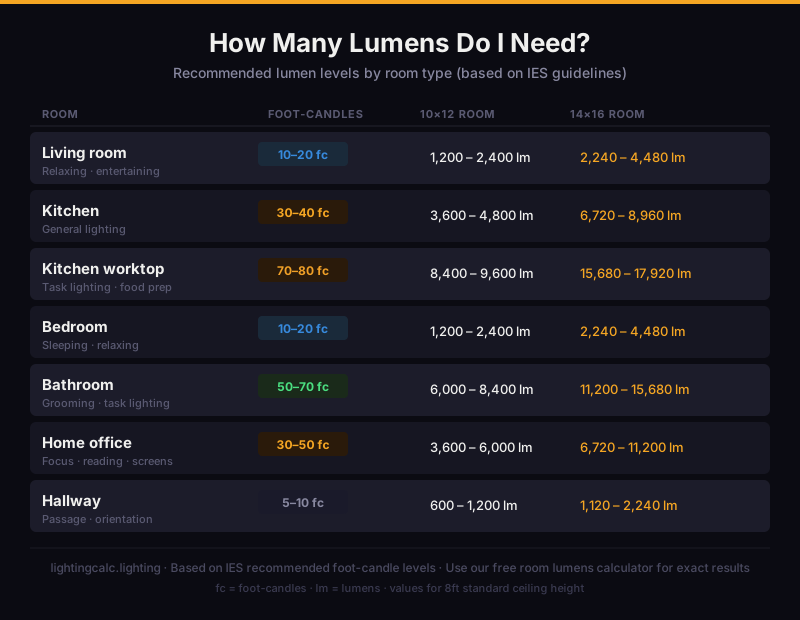
According to guidelines from the Illuminating Engineering Society, recommended light levels vary by room type and intended use.
Here are the recommended foot-candle levels and lumen estimates for the most common rooms in a home. These are based on guidelines from the Illuminating Engineering Society (IES).
Does Ceiling Height Change How Many Lumens You Need?
Yes — significantly. Light from a recessed fixture has to travel further before it reaches the floor or work surface when ceilings are high. The general rule is to increase your lumen target by about 10 percent for every foot above eight feet.
A room with a ten foot ceiling needs roughly 25 percent more lumens than the same room with an eight foot ceiling. A room with a twelve foot ceiling needs about 50 percent more.
How Many Bulbs Do You Need?
Once you know your total lumen target, divide it by the lumens of the bulbs you plan to use. A standard LED bulb produces around 800 lumens. A brighter LED might produce 1,100 lumens. A recessed can light typically produces 650 to 800 lumens.
For example: a living room measuring 14 by 12 feet needs roughly 2,500 lumens. Divided by 800 lumens per bulb, that is about 4 bulbs — or 4 to 5 recessed lights.
Use Our Free Room Lumens Calculator
Rather than doing the maths manually, our room lumens calculator handles everything automatically. Enter your room dimensions, select your room type, choose your ceiling height, and get your exact lumen target plus bulb and recessed light recommendations instantly.
Lumens vs Watts — What’s the Difference?
Lumens measure brightness. Watts measure energy use. For decades people used watts as a proxy for brightness because all bulbs were incandescent and 60W always meant roughly the same brightness. LED bulbs broke that relationship entirely. A modern 10W LED produces the same 800 lumens as a 60W incandescent. Always shop by lumens, not watts.